
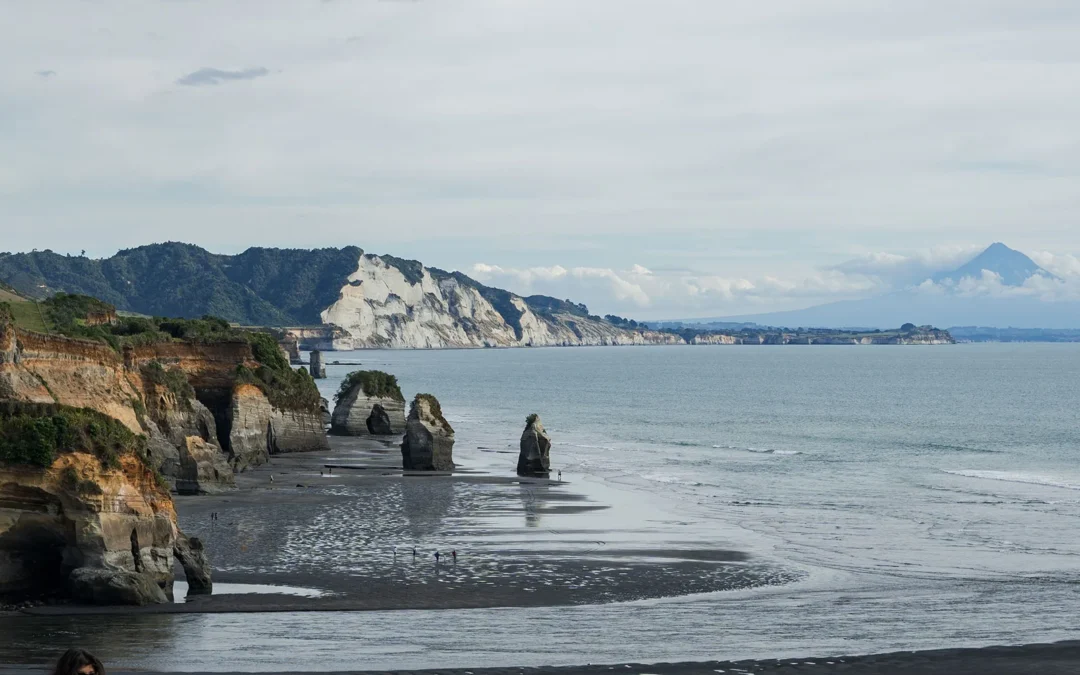
Regional development is not a slogan. It is the practical work of helping people build successful businesses, skilled jobs and resilient communities in the places they call home.
Taranaki offers a compelling example, but Regional Development is a national portfolio. The objective is to help every part of New Zealand identify its productive strengths, remove barriers to investment and create more value before our products leave the country.
A national economy needs more than one centre
Auckland accounted for 37.5% of New Zealand’s nominal GDP in the year ended March 2025. Taranaki accounted for 2.6%, but produced GDP per person of $85,095—among the country’s highest regional results. These figures do not justify taking opportunity away from Auckland. They show why New Zealand should build more productive centres in which firms can invest, employ skilled people and export. The Parliamentary Library summarises the latest Stats NZ regional GDP release.
A successful national strategy should welcome Auckland champions such as Fisher & Paykel Healthcare, whose East Tāmaki investment combines research, manufacturing and distribution. At the same time, it should create credible alternatives for businesses whose growth depends on larger sites, reliable energy, affordable premises and freight access. Fisher & Paykel Healthcare’s current Auckland expansion shows what high-value New Zealand manufacturing can achieve.
A 2025 Auckland planning assessment records high industrial land values, rising construction costs and increasing pressure on land-extensive activities. In the area assessed, industrial land values had doubled from an average of $600 per square metre in 2019 to $1,200, while vacancy was below 1%. That is location-specific evidence, not proof that all Auckland manufacturing is unviable. It does, however, reinforce the need for well-planned regional industrial options. Read the Auckland planning assessment.
A productive economy starts in the regions
Small businesses are not a side issue in New Zealand’s economy. They make up about 97% of our enterprises and contribute around 42% of our economic value. Manufacturing contributes approximately 8.6% of GDP, supports about 247,000 jobs and accounts for around 60% of exports. About 96% of manufacturing firms employ fewer than 50 people. These figures come from the Ministry of Business, Innovation and Employment.
Advanced manufacturing is already deeply regional. MBIE’s regional evidence shows that it represents 16.8% of employment in Southland, 16.3% in Taranaki, 15% in Marlborough and 13.1% in Hawke’s Bay. These are not peripheral industries. They are major sources of skilled work, exports, apprenticeships and local supply-chain demand. See MBIE’s advanced-manufacturing regional evidence.
When a viable local business closes, a region loses more than a storefront or workshop. It loses skills, apprenticeships, suppliers, community sponsorship and the accumulated knowledge required to create the next generation of businesses.
Add value before our products leave New Zealand
New Zealand is very good at producing raw and lightly processed materials. We now need to become much better at turning those resources into finished, higher-value products.
That could mean advanced wood products rather than unprocessed logs, branded food and fibre products rather than bulk commodities, and more specialist engineering, environmental technology, biotechnology and precision manufacturing. The goal is not for Wellington to choose one preferred industry. It is to build the conditions that allow good firms to test, scale and compete.
Taranaki brings together engineering and fabrication skills, energy expertise, food and fibre production, emerging biotechnology, industrial infrastructure and New Zealand’s only deep-water port on the west coast. Its regional investment prospectus also identifies more affordable industrial land and operating costs than larger cities. That makes Taranaki an excellent proof point—but the same approach should be repeated around each region’s genuine strengths. Read Taranaki’s 2026 investment prospectus.
What regional manufacturing needs
- Industrial land: suitable sites protected from incompatible uses and connected to essential services.
- Abundant, dependable energy: generation and networks capable of supporting processing, engineering and advanced manufacturing.
- Freight and digital connections: roads, rail, ports and broadband that connect producers with suppliers and customers.
- Skills and research: vocational training, regional innovation hubs and practical access to scientists, engineers and commercialisation support.
- Patient capital and capability: finance, management support, export knowledge and certification assistance for small and medium firms.
- Stable rules: regulation and infrastructure plans that endure beyond one election cycle.
Technology should strengthen productive capability
New Zealand must embrace artificial intelligence, automation, robotics, digital design and emerging technology industries. But technology is not an economy by itself. Its greatest value is in helping people and businesses design better products, reduce waste, improve quality, reach customers and produce more value from every hour worked.
Opportunity’s Breakthrough Economy policy supports stronger science and research funding, technology-investment incentives, regional innovation hubs and more practical capability support for small businesses. Its Abundant Energy policy links affordable clean energy with opportunities in primary processing, manufacturing and transport. That is the right direction: innovation connected to real firms, skilled workers and useful products.
Turn trade access into export opportunity
New Zealand has negotiated valuable access to international markets. The CPTPP economies took 28.7% of New Zealand’s goods exports in the year ended December 2025, and more than 90% of our manufactured-goods trade with its new FTA partners became duty free when the agreement entered into force. The Ministry of Foreign Affairs and Trade provides the detailed market-access information.
Signing an agreement is only the beginning. Regional businesses still need working capital, market knowledge, certification support, production capacity and reliable infrastructure to turn access on paper into sales. We should measure trade success not only by tonnes exported, but by the value, intellectual property and skilled employment retained in New Zealand.
Government should be a capable partner
Local and central government cannot guarantee that every business will succeed. They can stop making growth unnecessarily difficult. Regional firms need clear pathways through regulation, infrastructure that supports production, fair competition, access to skills and research, and public agencies that understand the realities of small business.
Holding Opportunity’s Regional Development, Local Government and Internal Affairs portfolios, Sarah can connect economic development with the institutions and infrastructure that make it possible. Her focus is straightforward: help every region create more value, give viable businesses a fair chance to grow, and ensure technology strengthens New Zealand’s productive base rather than replacing it.
A stronger New Zealand economy will be built by people who make, grow, design, repair, invent and export—in Auckland and throughout our regions. Government’s job is to help create the conditions in which they can succeed.